
In the Presence of Harry Styles: A Lesson in Space, Safety, and Shared Humanity
There are moments in life that arrive quietly, without expectation, and then linger—moments that shift something subtle but profound inside you. This was one of those moments.
It started casually. Harry Styles was in Amsterdam for a series of shows, just 35 minutes from where I live. I wouldn’t have called myself a fan. I knew who he was, of course—he’s everywhere—but I hadn’t followed him closely. But in a call with my best friend, the day before the show, she insisted it was a cultural moment, something worth witnessing. She couldn’t believe I lived in one of the few places where he was performing and I wasn’t planning to go. So the day before the show, I bought cheap tickets and decided to bring my family. It felt spontaneous, almost trivial.
It wasn’t.
What I experienced that night—and in the days that followed—caught me off guard. It was something hard to articulate, something that stayed with me, asking to be understood.
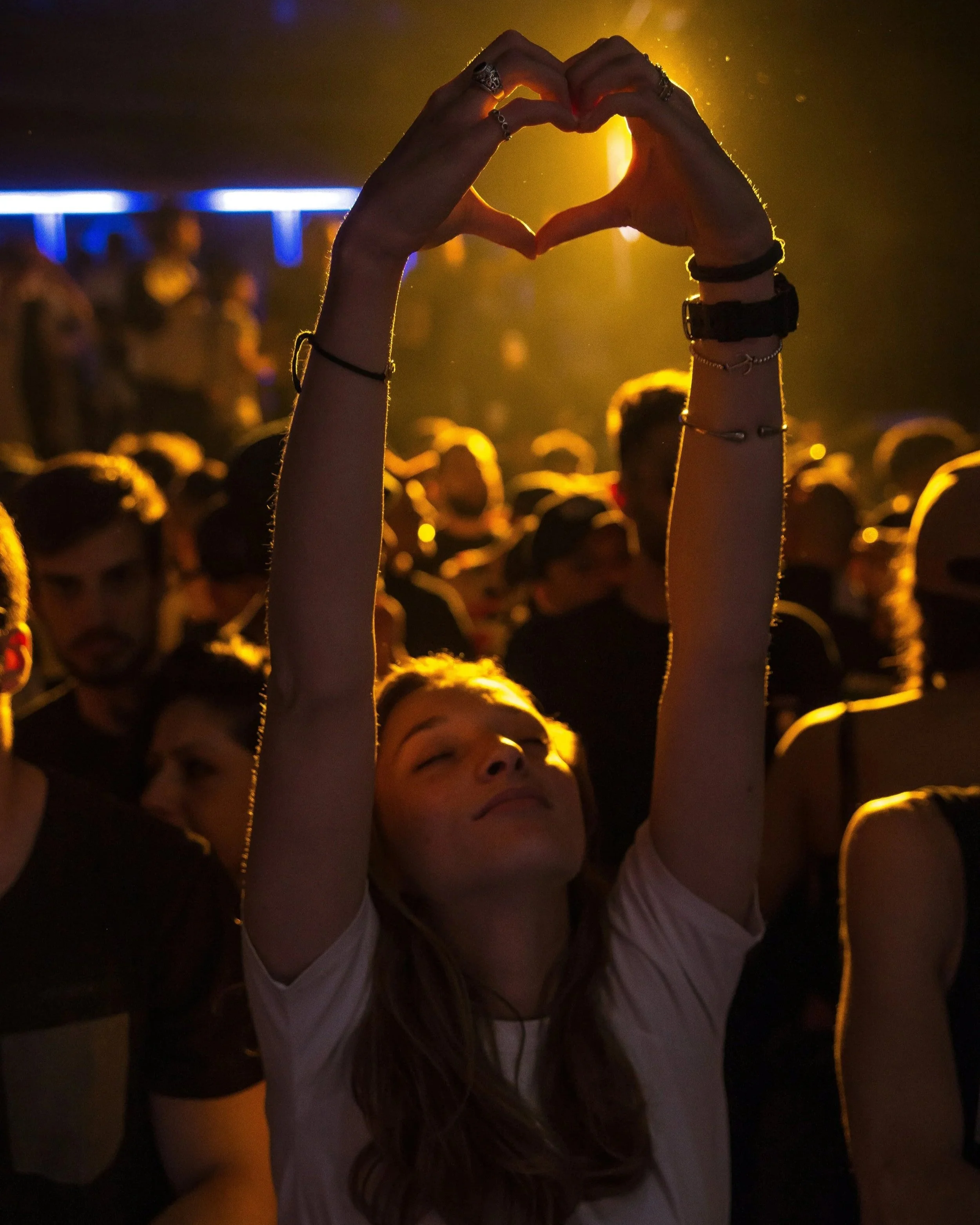
Sitting high up in the nosebleed seats (the reason why the tickets were so cheap), I watched the general admission crowd below. And what I saw felt unfamiliar in the best way. People weren’t performing for their phones. They weren’t documenting themselves being there. They were simply there—lying on the ground between sets, jump roping together, laughing, starting conga lines, creating dance circles for the people in wheelchairs, sharing space.
It moved me in a way I didn’t expect.
My memory of concerts—especially growing up in the 90s—was very different. There was aggression, chaos, mosh pits, and a very real of danger. I remember losing shoes, being shoved, and getting groped. Being “in the moment” meant pushing into the crowd, enduring whatever came with it. It didn’t feel safe. It didn’t feel like a space where you could fully be yourself.
But this space, inside of the huge Johan Cruyff stadium, was being held in a way that allowed people to feel safe enough to soften. This idea of “holding space”—that I’d learned through coaching and teaching yoga—was happening on a much bigger scale.
Holding space means creating an environment where people can show up as they are, without fear of judgment, without needing to perform. It’s about removing yourself from the center so others can step into their own experience.
Watching that crowd, it was clear: this space wasn’t about the performer demanding attention. It was about allowing people to embody something for themselves.
It connected to something deeper that I’ve been learning in my own life. As a yoga teacher, I had to confront my own insecurities—wondering if I was good enough, experienced enough, worthy enough to guide others. But after teaching just a couple of classes, something shifted. I realized it wasn’t about me at all. My role wasn’t to impress anyone. It was to create a space where others could go inward, feel safe, and have their own experience.
And that’s what I saw mirrored at the concert.
In a world that feels increasingly loud, divided, and volatile, there’s something powerful about spaces that feel safe. Spaces where people can gather without fear. Spaces where connection feels natural rather than forced. My daughter once described concerts as “a group hug.”
We are all craving that feeling.
For many of us—especially women—feeling safe in public spaces has not been the norm. I spent years navigating environments where attention felt invasive rather than affirming, where being seen meant being objectified. Concerts, clubs, crowded places—they weren’t spaces where I could relax or turn inward. They were spaces where I had to stay alert.
So when I realized that I now feel safe enough—in yoga, in certain communities, even in moments like this concert—to simply exist in my body without self-consciousness, it hit me deeply. That sense of safety isn’t small. It’s transformative.
And it made me see how important these spaces are.
They aren’t just entertainment. They allow us to release tension we didn’t realize we were holding. They give us permission to soften, to feel, to connect. They remind us that we are not alone.
This is especially important now. After years of isolation, after living through collective stress and uncertainty, we are relearning how to be together. There’s a kind of cautiousness, even lingering fear, but there’s also a growing desire to reconnect. To gather. To feel something shared.
And maybe this is where change begins—not in loud, aggressive ways, but in softer, more intentional ones. In spaces where people feel safe enough to be themselves. In moments where we choose connection over division.
This idea extends beyond concerts or yoga studios. It shows up in how we work, how we lead, how we interact with others. When we understand our own value, we show up differently. We set boundaries, create healthier environments, and contribute in ways that feel aligned rather than forced.
It also shows up in how we handle our own imperfections. Showing up and being vulnerable, whether as an artist, a parent, or as a teacher, means making mistakes. The difference is in what we do afterward. Do we spiral into shame, or do we acknowledge, learn, and let go?
That process—showing up, failing, reflecting, releasing—is part of holding space too. Not just for others, but for ourselves.
And maybe that’s the thread that ties all of this together.
We are all, in our own ways, searching for spaces where we can feel safe enough to be our true selves. Spaces where we can let go of performance, comparison, and fear.
Sometimes those spaces look like a yoga class. Sometimes they look like a conversation. And sometimes, they look like a concert you almost didn’t go to.
What matters is what we take from them.
If we can carry that feeling—the openness, the kindness, the sense of shared humanity—into our everyday lives, then maybe those moments aren’t fleeting after all. Maybe they’re the beginning of something larger.
Because in a world that people are working hard to convince us is divided, even small moments of connection become our movement, our hope in humanity.
And sometimes, all it takes is being willing to step into the space—and receive what’s already there.
Thanks Harry.